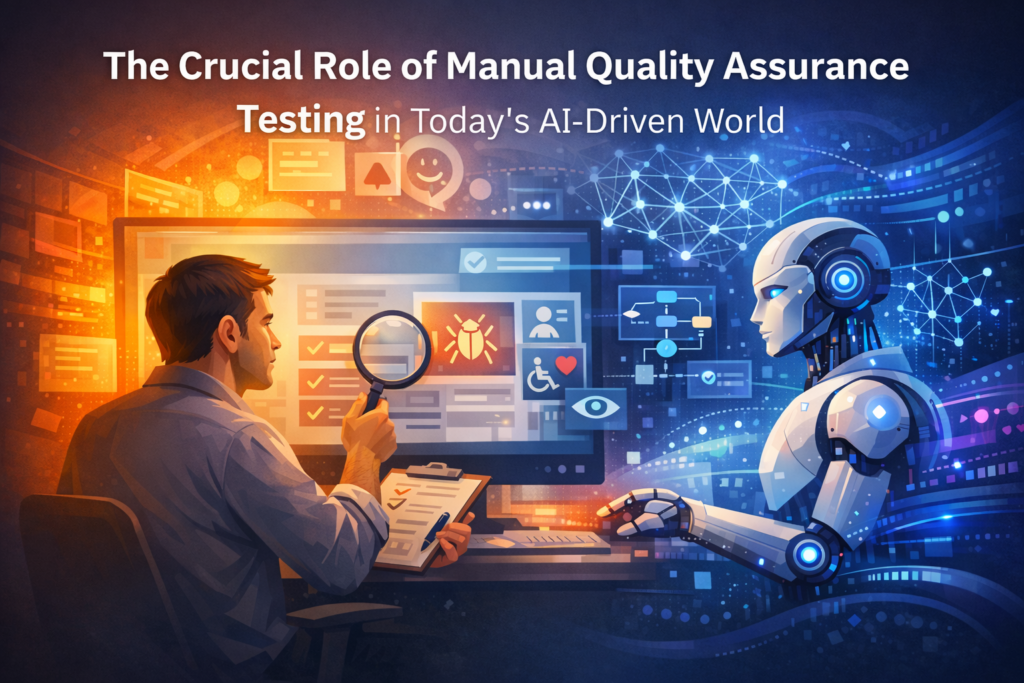
Artificial Intelligence and automation have immensely disrupted the technological space. Today, AI-integrated modern tools are capable of executing the entire test suite in minutes, identifying patterns, bugs and enhancing efficiency during the process of building and testing software.
But, with every new AI achievement, we circle back to the same question – “Will AI replace humans?” or, in this case, “Is Manual Quality Assurance (QA) testing still required?”
Even at its peak, the value of humans doesn’t disappear. So yes, for individuals or enterprises working with large-scale systems, complex products or user-centric software, manual testing is absolutely essential. Why? Because certain aspects, such as contextual awareness, human intuition and experiential awareness, are beyond the scope of automation.
Let’s further explain why manual quality assurance testing continues to hold a strategic importance even in today’s AI-powered world.
Human Insight: The Core Of Quality Assurance
Automation helps achieve unmatched speed, consistency, accuracy and efficiency. But it cannot match the nuance of human perception. No doubt that AI systems can confirm functional accuracy, but AI systems currently offer no reliable metrics to accurately measure natural, intimate and genuine user satisfaction.
Manual QA testers bring emotional response, real-world context and user psychology– something beyond the scope of AI. Their human insight is useful in understanding that a software is not just functional, but also experience-centric, meaningful and resonates with the users.
Exploratory Testing: Beyond Predefined Paths
Exploratory testing mirrors real user experience and is therefore an inherently creative, intuitive and unscripted process. Even the most advanced automated systems are yet to deliver the curiosity, improvisation, contextual reasoning and adaptability that only human QA testers can emulate. Manual testing uncovers the most subtle edge cases and bugs that automated systems would often overlook.
Ensuring Real World Reliability
Real-world users do not follow a script. They interact with software in unpredictable ways, which rarely align with the predefined logic of automation systems. Manual QA testing is the only reliable way to simulate such unusual paths and inconsistent choices, revealing defects, usability flaws and bugs that AI cannot detect.
Catching What Automation Misses
Manual testers excel at identifying nuance, which even the most advanced AI struggles to understand, such as:
- Visual, design or layout inconsistencies.
- Usability and accessibility flaws.
- Confusing or misleading workflows.
- Logical issues that are not traditional bugs.
- Issues that require human interpretation, intuition and judgement.
AI automation is exceptional at handling repetitive tasks and large data, but humans excel at handling complexity, emotions and context.
Deep Business & Domain Understanding
For a business-centric software, manual testing is indispensable because only humans can offer the true understanding of business goals, technical requirements and the contextual knowledge that often machines cannot comprehend.
Manual QA testers understand:
- Business rules and regulations.
- Target demographic and market.
- Customer expectations.
- Industry-specific diction
Accessibility & Inclusivity For All
While AI can ensure basic technical compliance, it’s the job of manual testers to ensure accessibility to all, such as ease of use for those with visual or physical impairment, intuitive working of assistive technologies, etc.
Testing for accessibility includes:
- Testing for visual contrast and readability.
- Easy keyboard navigation paths.
- Testing screen reader behavior and clarity.
- Testing for easy usability for all differently abled users.
Human Feedback Powers Better Products
Manual QA testing feedback reports are more constructive than bug reports. It offers a more in-depth insight, offering improvement opportunities while keeping the business logic in mind. Their partnership with designers, developers and product teams results in:
- A smoother and more efficient workflow.
- A clearer and intuitive UI.
- Defined and frustration-free user journeys.
- Higher customer trust and user satisfaction.
Manual Testing In Regulated Industries
Sectors like banking, healthcare, aviation and government operate with strict compliance and safety standards. Here, manual testing is mandatory.
In such sectors, even minor software errors can cause physical harm. Therefore, documented human approval is required before anything goes live. Manual QA offers human oversight, accuracy and human accountability.
Manual QA and AI: A Powerful Partnership
The goal of Artificial Intelligence isn’t to replace humans, but to reduce human error and improve accuracy. There is no competition between humans and machines. While automation can expertly handle repetitive tasks and large data stores, and improve coverage, it does not relieve manual testers of their job. Instead, they are left to focus on offering the necessary oversight for more complex and nuanced evaluations that require human understanding, judgment and empathy.
The collaboration between AI and humans offers tangible results like:
- Efficient and faster development cycles.
- Higher accuracy and improved risk detection.
- Better feedback loop for product development.
- Improved productivity.
- More refined, user-friendly UI.
- Stronger regulatory assurance.
- Better team collaboration.
Quality assurance is a craft requiring patience, skill, dedication to delivering quality and a keen eye for details. Manual QA testers, especially those with globally recognized certifications like the ‘ISTQB’, bring the necessary skills and knowledge of quality standards to the table.
So even in an AI-driven era of technology, the understanding, emotional insight, creativity and context human testers bring is unmatched. They are the backbone of user-friendly, high-quality software.
So, can you get away with not using manual QA testing?
Short answer – NO.
Where AI can make testing faster, manual QA can make it better and more reliable. If you aim to build high-quality digital experiences, you need a collaborative effort between machines and humans. Find the balance and there will be nothing stopping your success.