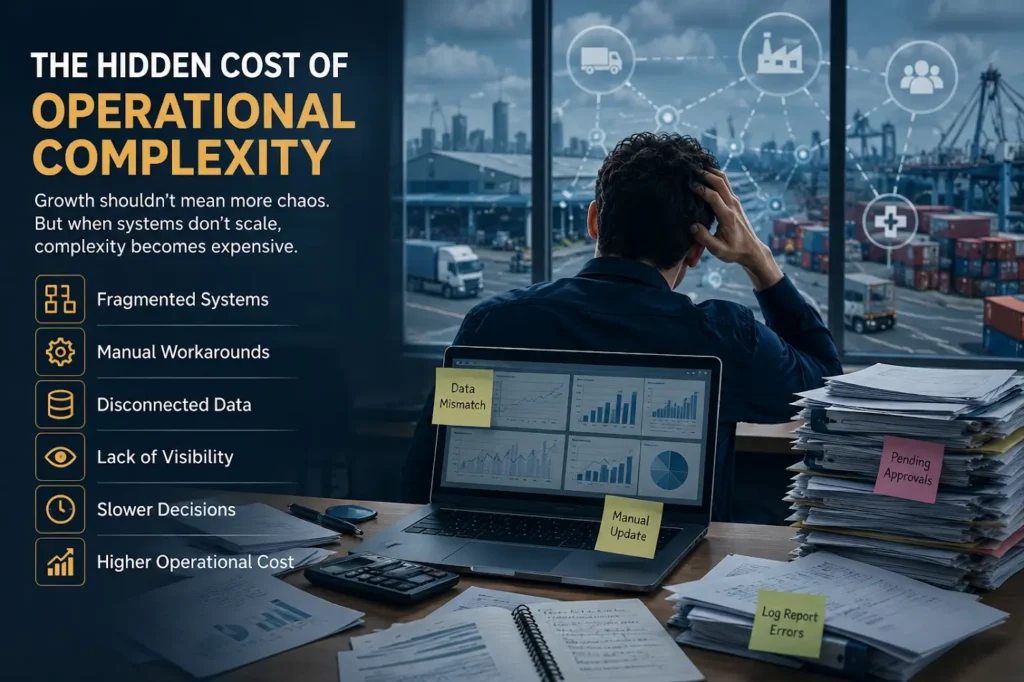
Most businesses don’t wake up one day and decide their systems are no longer working.
In reality, operational complexity builds gradually.
A process that worked perfectly for a team of 10 employees may become inefficient when the organization grows to 50. A platform designed for one location may struggle when operations expand across multiple regions. What once felt manageable slowly becomes harder to control, harder to track, and harder to scale.
The challenge is that these problems rarely appear overnight.
They develop quietly in the background until they begin affecting productivity, visibility, customer experience, and ultimately business growth.
Growth Creates Complexity
Growth is generally viewed as a positive sign for any organization.
- More customers.
- More orders.
- More employees.
- More locations.
- More data.
However, every stage of growth introduces new operational demands.
Processes become more complicated. Information starts moving between departments. Teams adopt additional tools to solve immediate problems. New workflows emerge without formal planning.
Over time, organizations often find themselves operating across multiple systems, spreadsheets, communication platforms, and manual processes.
Each individual solution may have been created with good intentions.
Together, they create operational complexity.
The Signs Often Appear Earlier Than Expected
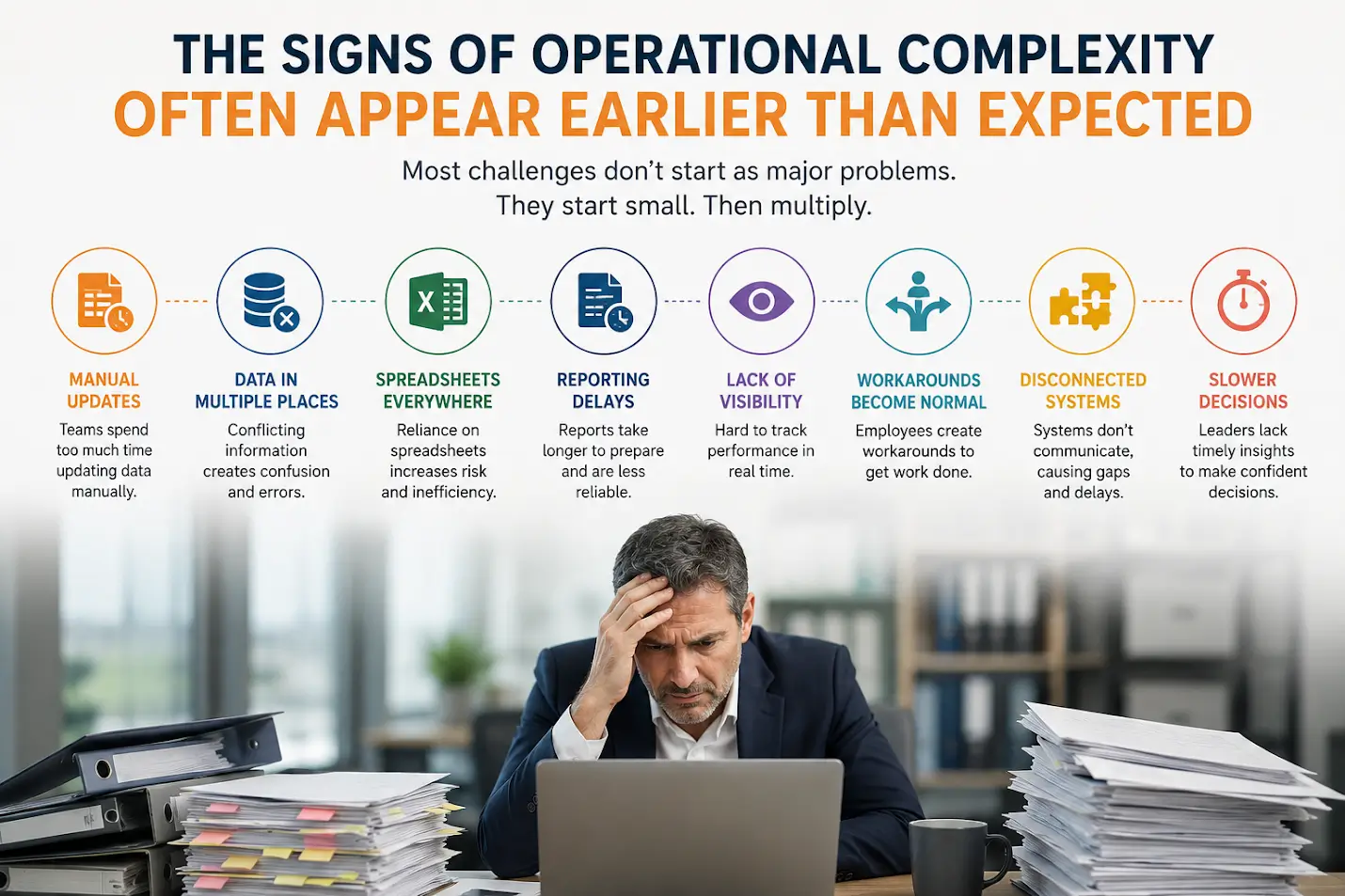
Many business leaders first notice the symptoms rather than the root cause.
Common signs include:
- Teams spending significant time manually updating information.
- Data existing in multiple locations with conflicting versions.
- Increased dependency on spreadsheets.
- Reporting becoming slower and less reliable.
- Difficulty tracking operational performance in real time.
- Employees relying on workarounds to complete routine tasks.
- Delays caused by disconnected systems.
These issues are frequently accepted as “the way things work.”
In reality, they often indicate that existing systems are no longer aligned with how the business operates today.
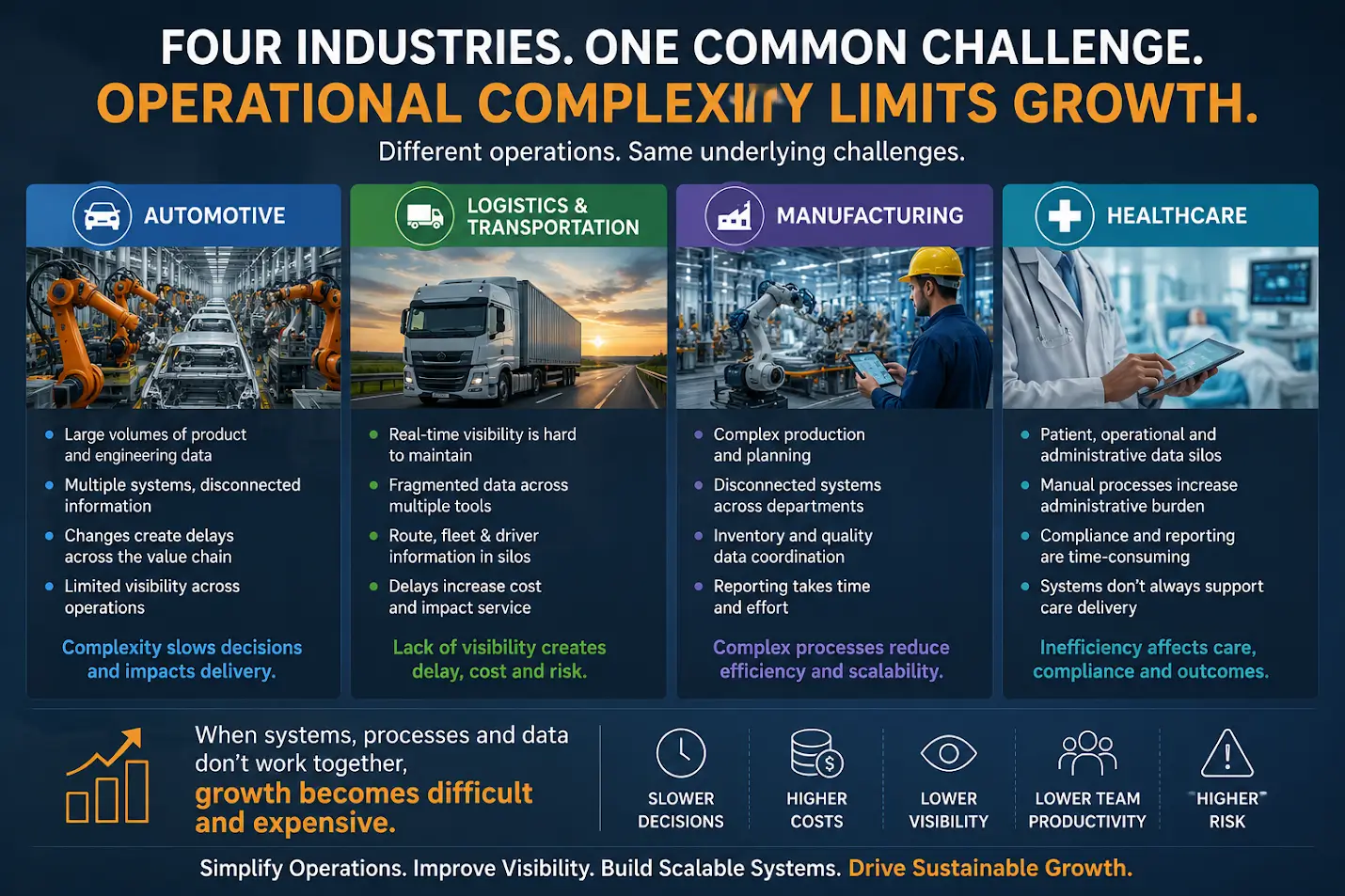
Automotive Operations: When Information Becomes Difficult to Manage
Automotive businesses often manage large volumes of technical, operational, and customer-related information.
As organizations grow, data may become distributed across different systems, departments, and teams.
Without proper visibility, employees spend more time searching for information, verifying accuracy, and managing exceptions.
The result is slower decision-making and increased operational overhead.
The problem is rarely a lack of technology.
More often, it is a lack of alignment between systems and operational needs.
Logistics & Transportation: Visibility Becomes Critical
In logistics and transportation, operational success depends heavily on visibility.
Orders, vehicles, drivers, schedules, customers, compliance requirements, and operational data are all interconnected.
As operations expand, organizations often discover that information is fragmented across multiple platforms.
A delay in one area can quickly affect multiple parts of the business.
Without accurate and accessible operational visibility, managers are forced to spend more time gathering information and less time acting on it.
Growth increases the need for clarity.
Unfortunately, many systems were never designed for the scale they are now expected to support.
Manufacturing: Complexity Often Increases Faster Than Capacity
Manufacturing organizations continuously balance production, inventory, procurement, quality control, and operational planning.
As facilities expand and processes evolve, operational complexity grows naturally.
Many organizations accumulate systems over time, each solving a specific business need.
The challenge emerges when these systems stop working together effectively.
Departments begin operating with different versions of information. Reporting becomes difficult. Process inefficiencies become harder to identify.
What initially appears to be a technology issue is often an operational visibility issue.
Healthcare Operations: Efficiency Directly Impacts Service Delivery
Healthcare organizations face unique operational demands.
Patient information, scheduling, compliance requirements, reporting obligations, and service delivery processes all depend on reliable systems and workflows.
As healthcare operations expand, manual processes and disconnected systems can create unnecessary administrative burdens.
Teams often spend valuable time managing information instead of focusing on service delivery.
Improving operational efficiency is not simply about technology.
It is about ensuring systems support the people and processes responsible for delivering care.
The Hidden Cost Most Organizations Overlook
The financial impact of operational complexity is often difficult to measure directly.
However, the costs appear in many forms:
- Lost productivity.
- Delayed decisions.
- Increased administrative effort.
- Reduced visibility.
- Higher operational risk.
- Slower response times.
- Difficulty scaling operations.
Because these costs are distributed across departments, they are frequently underestimated.
Yet over time, they can significantly affect growth and profitability.
Technology Is Not Always the Answer
One common misconception is that every operational challenge requires new technology.
In many cases, organizations already have the necessary tools.
The real challenge is understanding how people, processes, and systems interact.
Successful modernization begins with understanding how the business actually operates.
Only then can organizations determine whether processes should be improved, systems should be optimized, or platforms should be redesigned.
Technology should support operations.
It should not create additional complexity.
Looking Ahead
Operational complexity is a natural byproduct of growth.
The question is not whether complexity will appear.
The question is whether organizations recognize it early enough to address it before it becomes a barrier to performance and scalability.
Businesses that continuously evaluate their processes, systems, and operational visibility are often better positioned to adapt, scale, and compete in an increasingly complex environment.
The organizations that grow most successfully are rarely those with the most technology.
They are the organizations whose systems continue supporting the way their business needs to operate.
CEO Insight
“Over the last two decades, I’ve worked with organizations across different industries that faced remarkably similar challenges. The technology was often different, but the underlying issue was the same; systems that were no longer aligned with the way the business had evolved. In my experience, the most successful modernization initiatives begin by understanding operational realities first and technology second. When businesses focus on aligning people, processes, and systems, meaningful transformation becomes much easier to achieve.”
— Parminder Singh Ubhi
Founder & CEO, Qualhon Informatics