As businesses grow, there’s a point where things start to feel slower.
Not because the team isn’t capable. Not because the technology is outdated.
But because something underneath is no longer working the way it should.
And this is where most companies misread the situation.
They assume it’s a technology problem.
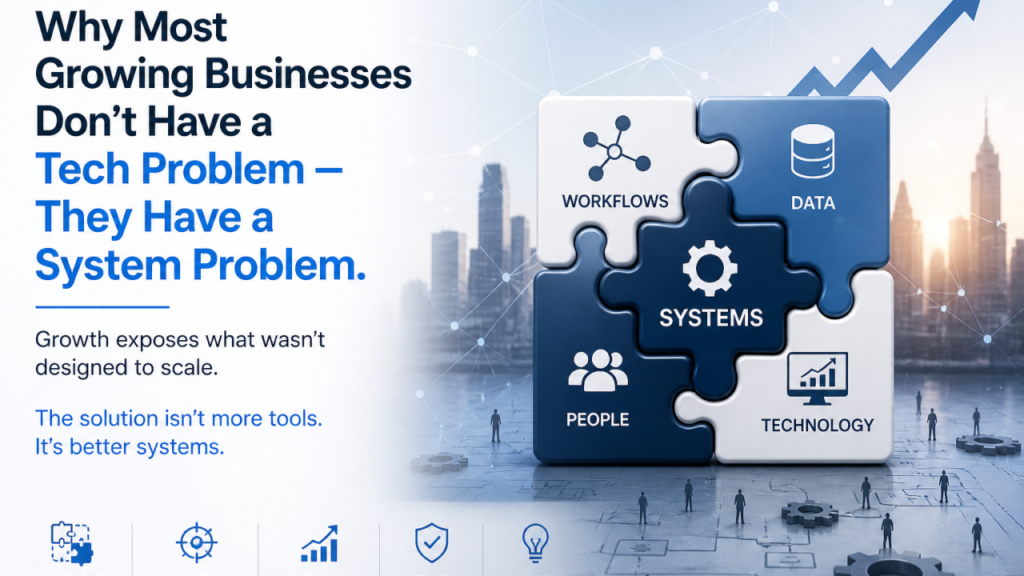
In reality, it’s a system problem.
The Misunderstanding
When operations become complex, the first instinct is usually:
- We need better tools
- We need more automatio
- We need to upgrade our tech stack
So teams start adding:
- new software
- additional integrations
- reporting layers
For a while, this seems to help.
But over time, things start getting worse — not better.
What’s Actually Happening
The issue is rarely about lack of technology.
It’s about how systems are structured.
Over time, most growing businesses end up with:
- Multiple tools solving isolated problems
- Data scattered across different platforms
- Workflows that depend heavily on manual coordination
- Processes that were never designed to scale
Nothing is technically “broken”.
But everything becomes harder to manage.
The Scaling Effect
At a smaller scale, these inefficiencies are manageable.
- Teams communicate directly
- Workarounds are easy
- Exceptions are handled manually
But as the business grows:
- Dependencies increase
- Volume increases
- Complexity increases
What worked earlier starts becoming a bottleneck.
And the system begins to slow the business down.
The Real Patterns We See
Across different industries, the patterns are surprisingly similar:
- Fragmented Systems Different tools exist, but they don’t truly work together.
- Data Without Clarity Data is available, but not structured in a way that supports decision-making.
- Workflow Dependency on People Processes rely on individuals instead of being system-driven.
- Increasing Operational Friction More time is spent managing processes than actually moving the business forward.
Why Adding More Tools Doesn’t Fix It
When systems start breaking down, the common reaction is to add more layers.
But this often creates:
- more complexity
- more dependencies
- more points of failure
Instead of solving the problem, it delays it.
The Shift That Needs to Happen
The real shift is not technical.
It’s structural.
Businesses need to move from:
Tool-based thinking to –> system-based thinking
This means asking:
- How should workflows actually operate at scale?
- What needs to be automated, and what needs control?
- How should data flow across the business?
- Where are the real bottlenecks?
A More Practical Perspective
In many cases, the answer is not to rebuild everything.
It’s to:
- bring clarity to how systems should work
- simplify what has become overly complex
- align technology with actual business operations
Final Thoughts
- Growth doesn’t break businesses.
- It exposes what was never designed properly in the first place.
- And often, the challenge is not about building more.
- It’s about understanding what needs to change.